
Overview
A paper mill in the southeastern United States avoided a potentially catastrophic transformer failure and significant unplanned downtime by leveraging airborne ultrasound technology, including an Si2-PRO Acoustic Camera and Ultraprobe 10,000, to identify a hidden defect undetected by traditional inspection methods. What ultimately required only a minor corrective action had the potential to escalate into a multi-day outage, resulting in substantial production losses and equipment replacement costs.
The facility operates a critical paper production line powered by a 10,000 kVA transformer (13.8 kV to 2.3 kV) supplying a paper machine. This asset is essential to continuous operations, where downtime is valued at approximately $25,000 per hour. As part of a proactive reliability program, the site performs quarterly ultrasound and infrared inspections in addition to routine oil analysis and visual inspections.
Nearly $1 Million in Risk Avoided
By identifying and correcting the defect before failure occurred, the facility:
- Avoided unplanned downtime
- Prevented a potential multi-day outage
- Avoided production losses valued at approximately $25,000 per hour
- Avoided an estimated $150,000 transformer replacement cost
- Reduced total operational risk approaching $1 million
“We made two attempts to locate the source of the noise inside of the cabinet and failed both times. All traditional sources were eliminated, and we were running out of options. The Si2-PRO Camera delivered outstanding results by pinpointing the source of the noise. Without the use of the camera, I doubt we would have been able to locate the issue. The camera took all the guesswork out of the equation. I would highly recommend this unit.” – Anonymous Employee
THE CHALLENGE
A Persistent Problem with No Clear Cause
For several months, the maintenance team experienced intermittent ultrasonic electrical noise within the transformer. The issue appeared sporadically and raised concerns about the long-term reliability of a critical production asset.
Because the transformer powers a paper machine essential to operations, any unexpected failure could result in significant production losses and extended downtime. Despite ongoing monitoring efforts, the source of the abnormal condition remained unknown.
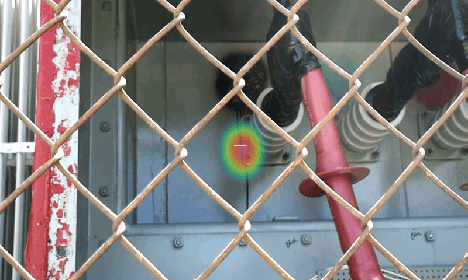
Si2-PRO Acoustic Camera identification of the sound source at the transformer bushing connection.
When Traditional Methods Came Up Empty
To determine the cause of the issue, the facility relied on several established inspection technologies and maintenance practices.
Infrared thermography revealed no thermal anomalies. Visual inspections were inconclusive, and oil analysis showed no indications of insulation breakdown or deterioration. Previous corrective efforts also failed to eliminate the problem.
While the symptoms persisted, none of the traditional inspection methods could identify a root cause, leaving the facility with an unresolved reliability risk.
THE SOLUTION
Ultrasound Technology Reveals the Source
As part of the facility’s proactive reliability program, inspectors turned to ultrasound technology to further investigate the issue.
Using the Si2-PRO Acoustic Camera, inspectors detected high-frequency acoustic emissions and localized the source to a specific transformer component. Recordings were then collected using an Ultraprobe 10,000 and analyzed using spectral analysis software.
Data collected with the Si2-PRO Acoustic Camera and Ultraprobe 10,000 revealed indications of mechanical looseness and intermittent arcing, providing evidence that had not been detected through other inspection methods.
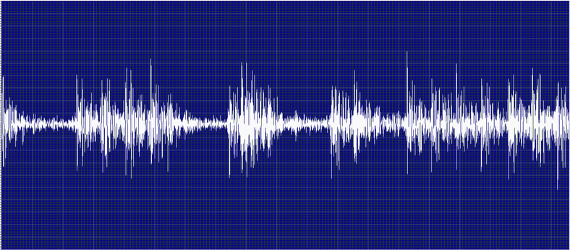
Ultraprobe 10,000 time wave form analysis showing impacting and ringdown associated with the transformer defect.
A Small Defect with Major Consequences
Guided by the ultrasound findings, inspectors performed a more detailed evaluation of the energized transformer while following all applicable safety procedures.
The source of the problem was traced to two loose bushing clamp nuts.
Analysis showed the nuts vibrating due to 60 Hz harmonics. This vibration produced impact and ring-down signatures visible in the ultrasound data. As the nuts vibrated, small intermittent arcs were generated, appearing in the time waveform analysis and stopping when the vibration ceased.
Because the arcing was intermittent and generated little heat, no thermal signature was present. As a result, the defect remained invisible to infrared inspections despite posing a significant reliability risk.
THE RESULTS
A One-Hour Repair Prevents a Major Failure
To correct the issue, the transformer was de-energized during a planned maintenance window lasting approximately one hour.
Technicians tightened the loose bushing clamp nuts by approximately one-eighth of a turn.
Following re-energization, ultrasound verification scans confirmed that the vibration, arcing, and abnormal acoustic signatures had been eliminated. No anomalies were detected during subsequent inspections.
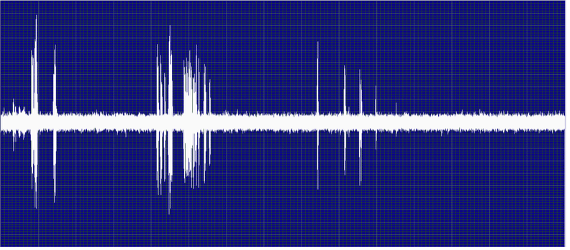
Ultrasound analysis identified intermittent arcing associated with the loose bushing connection.
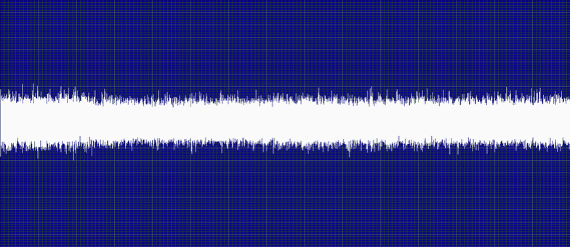
Post-repair verification scan confirmed the elimination of the vibration, arcing, and abnormal acoustic signatures.
Lessons Learned
- Not all electrical faults produce heat.
- Ultrasound identified mechanical looseness and intermittent arcing that produced no detectable thermal signature.
- Mechanical looseness and intermittent arcing may develop without generating enough heat to be identified through infrared inspections.
- Small defects can create substantial operational and financial risk if left unresolved.
- Sharing findings across maintenance and reliability teams strengthens overall asset management strategies.
Why It Matters
When traditional inspection methods failed to identify the source of a developing transformer defect, ultrasound technology provided the insight needed to localize the problem and guide corrective action.
By identifying two loose bushing clamp nuts before they could contribute to a larger failure, the maintenance team eliminated a potentially catastrophic issue with a one-hour repair and helped the facility avoid nearly $1 million in operational risk.